Neural Progressive Photon Mapping
In Computer Graphics Forum (Eurographics 2026), March 2026
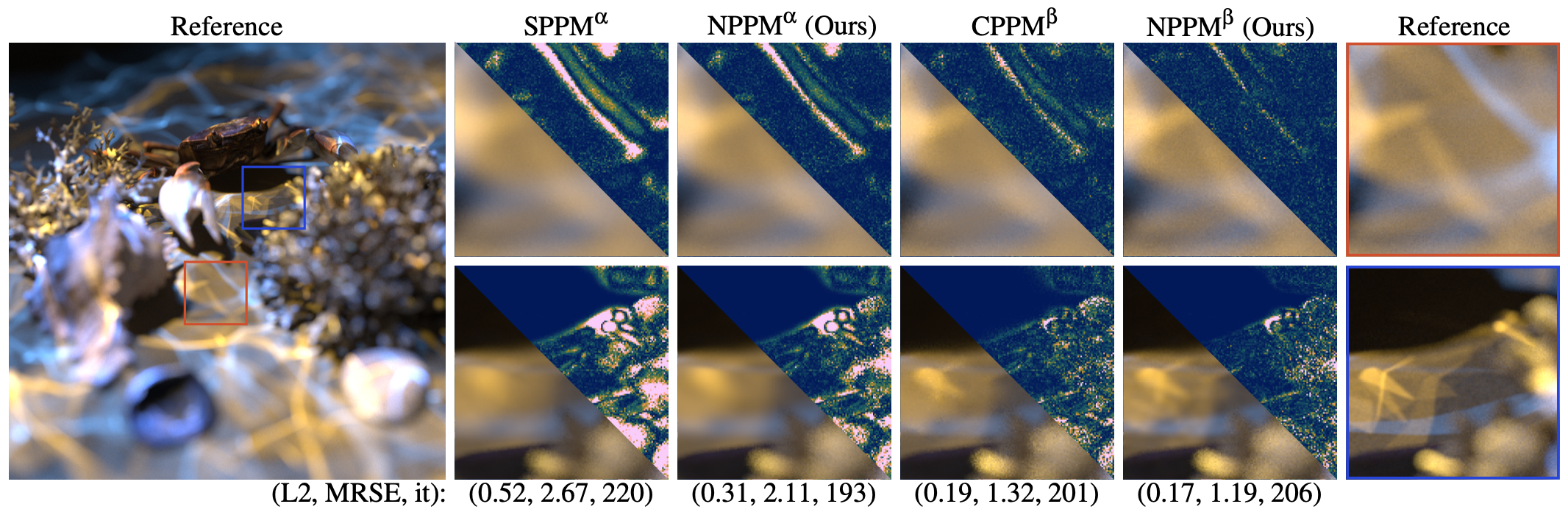
Equal-time comparison (15 seconds) between our neural progressive photon mapping (NPPM), SPPM and CPPM on the Crab DoF scene with depth of field. The superscripts α and β respectively refer to the different radius reduction policy used by the two baseline methods, which we incorporate atop NPPM. Our technique reduces the overall bias compared to its nonneural counterparts, capturing sharper caustics on most of the scene. False color error shows the MRSE metric.
Abstract
Photon density estimation is a robust solution for estimating complex light transport, such as those involving caustics and pure specular interactions. The shape and bandwidth of the density kernel are both crucial in achieving optimal performance. Recently, density kernels directly predicted by neural networks from local photon statistics have shown improved reconstruction results for small numbers of photons. The direct weight prediction approach of these methods, however, is fundamentally incompatible with consistent estimators as it does not allow for direct control over bias and variance. We address this problem by relying on a simpler yet effective analytical kernel, also inferred by a neural network. Unlike prior work, our technique supports progressive schemes by design, hence unlocking a large variety of applications such as stochastic photon mapping. Our method is fast, trivial to train and demonstrates state-of-the-art caustics reconstruction at equal-time over other photon mapping techniques.
Downloads
Publication
- Paper (author's version), PDF (9.2MB)
- Publisher's official version – external link, may require a subscription
- Primary website – external link
Code
BibTeX
Cite
Justin Benoist, Joey Litalien, and Adrien Gruson. Neural Progressive Photon Mapping. Computer Graphics Forum, 1 (1), Article 1, March 2026.
@inproceedings{Benoist:2026:NPPM, title = {Neural Progressive Photon Mapping}, author = {Justin Benoist and Joey Litalien and Adrien Gruson}, journal = {Computer Graphics Forum}, year = {2026}, month = mar, doi = {10.1111/cgf.70408} }Copy to clipboard